I’ve been meaning to write this entry for a bit. You see, if you’re going to write a blog from the perspective of a self-identified religious person, sooner or later you’ve got to explain what you really believe.
ברוך אתה ה’ אלהינו מלך העולם
Blessed are you, O God, Ruler of the Universe.
Many major prayers in Judaism begin with these words. At a certain point, you have to consider what it is we are blessing and praying to. I do not have a “typical” perspective on God. I don’t know if it’s unusual for Jews, but I know it’s unusual for the general public. It’s heavily steeped in Kabbalah with some Courtney snuck in there. There are three things I know about God:
- God is neither male nor female.
- God, while often anthropomorphized, is not human.
- God is everything.
God is neither male nor female.
I know this simply because of Genesis 1:27.
And God created man in His own image, in the image of God created He him; male and female created He them.
Though the Torah is often translated giving God male pronouns, this is out of convention and convenience, not out of factuality. Our language is limited and does not hold words to properly describe God’s attributes, so we call God a He. I was actually just reading about this issues in God Was in This Place and I, i Did Not Know It, by Lawrence Kushner. Kushner states:
The reason we have such a difficult time speaking of God is not God’s fault; the syntax of our language is the culprit.
He goes on to use the Abbott and Costello comedy routine “Who’s on first” to explain his argument…(it’s a really great book, you should read it.). Almost every contemporary book on Judaism discusses our struggle to describe God. No words in English or any other language do God justice. This brings me to #2.
God, while often anthropomorphized, is not human.
How disappointing if the infiniteness was just some person. That is not to say that God does not take human form. As I’ll get to in #3, I think God does just that. But God can not be drawn or described or characterized anymore than gravity or string theory. It is a concept beyond words and physical forms. God is so much greater than the body of a man or woman. A man or woman can only be in one place at a time, but God is everywhere. It’s why people all over the world feel confident praying to God and knowing that God is with them. God transcends our normal boundaries of flesh and time and space. So finally….
God is everything.
To this, I consider Christianity. I love Christianity. I think it’s a beautiful faith. I think there are many who, guided by Christ’s principles, live compassionate and productive lives. The most amazing thing about Christianity to me is the concept of Jesus being the Son of God. I totally believe that to be true. Where Christianity ends, and my thoughts begin, is that I am the daughter of God. My father and brother are sons of God, my sister and mother and niece are daughters of God. You, yes you, reading this, you are the son or daughter of God. Because to me, the truth of the matter is that we all carry the divine spark within us. If you could take that divine spark in everything around us and put it together, THAT is God.
Jews have so many different names for God. There is a super trendy book out there called The 72 Names of God by Yehuda Berg. The concept of 72 names for God comes from Exodus 14:19-21. There’s some fancy algorithm that you use to get all of the names and they are all imbued with special qualities. It’s sort of a weird passage to use for finding the names of God. That passage is about the drowning of the chariots when the Israelites were escaping Egypt.
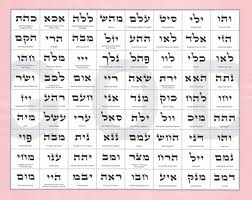
Theory is, by meditating and prayer towards one of these particular names, you will call on one of God’s generous characteristics to reign upon you. I think that’s a nice idea. I don’t know a lot about it, but it’s a nice idea. Honestly, I haven’t read the book, but it sounds like a pretty OK way to wrap people’s minds around the concept that God is not just one thing.
The legacy that Jews have in calling upon God as so many different things, goes to show that God is any and everything. For me, the most accurate name we have for God is Hashem (literally just “the name”) because by describing God, that is really all we are doing, putting a name on something that is there with or without our acknowledgement.
Going back to the first point I mentioned on this blog, most prayers begin with: Blessed are you O Lord our God, ruler of the universe. The question I get all the time from people who have heard my theory on God is “Well then who are you praying to if you don’t believe in a ruling God?”
You know in movies, when characters fall to their knees, look up and shout/cry in the rain? That’s sort of how I always feel when I pray. It’s sort of like me calling out through a megaphone to all of creation. That is why I believe singing prayer is so powerful, because the waves of sound can move throughout all of creation and bring about change. Prayer for me is a statement of purpose and intention. I believe that as Jews, our work of tikkun olam, rebuilding the world, is really about uniting all of God’s creations in order find true divinity. The kabbalists a lovely vessel analogy. I’ll use Michael Berg’s telling since I find it the most accessible:
The Creator’s desire to share implied the creation of something to share with […]. Kabbalistic teachings emphasize that because the Light was everywhere, the Vessel was formed of this sharing energy […] By the will of the Creator, the Vessel came instantly into being.
So basically, step 1: God created something to receive because God had an innate need to give. That is the Vessel and the Vessel is the everything. It was created to receive The Light from God. Berg continues:
It [the Vessel] wanted to become one with the all-giving Creator. But it could not achieve this as long as it could only receive and never give. So the Vessel pushed back against the Light […] In one immeasurably small moment the Vessel took the full force of the returning Light […] At that instant, the Vessel shattered. It exploded into an infinite number of fragments, which became our universe.
Step 2: the Vessel tries to give back to God, and at a certain point, the giving of God became so great that the vessel shatters and the universe around us is formed. The shards of that Vessel are full of divinity. It’s what I keep referring to as divine sparks. When I pray, I am sending a gathering cry to my fellow shards, my fellow sparks, invoking their power to do good, and asking for encouragement to do the same.
Hopefully, this gives you a little insight into how I feel about God. This is why I can’t believe in a condemning God, a wrathful God, a God who wants me to repent for sins. You can not sin, in my opinion. You can transgress against a fellow son/daughter of God, but you can not sin. There is no cloud man handing down rulings of failure. That is simply, not how I roll.
How do you conceptualize God? How did you get there? Does the commoditization of Kabbalah and other mystical religious paths make you cranky?
 And You Shall Love