I apologize for not writing for a while. Sometimes, my head gets so full of ideas that I shut down and stop writing entirely. Today, in torah study, we discussed one of my favorite symbols in the Torah, the Pillars of Cloud and Fire which attended the Israelites on their journey out of Egypt. More on those in a minute.
Concentric Circles Around God
My rabbi brought a lot of beautiful ideas forward today about the presence of God. How Moses ascended Mt Sinai and the Israelites were so nervous about not experiencing God that they built the golden calf and God punished them.
It seems incredibly patient of God to then instruct us to build a tabernacle to hold God’s presence with us all the time. Clearly, the Sinai model of traveling to see God does not work well for an innately insecure people. We need to feel God’s presence. So God says, build me this box, I’ll hang out here, and you can kind of carry my house along with you. When we then built the temple, we again built a house for God that was in one place and the community circled around it.
My rabbi describes the scene from Sinai as looking like this:

https://en.wikipedia.org/wiki/Biblical_Mount_Sinai
He said, that a birds eye view looks kind of like this:
In the red dot in the middle, is the top of the mountain, where Moses gets the tablets. In circles around the mountain is the community of Israel.
As we camped, we again created our community in concentric circles around the tabernacle, as this clever artist rendered it:
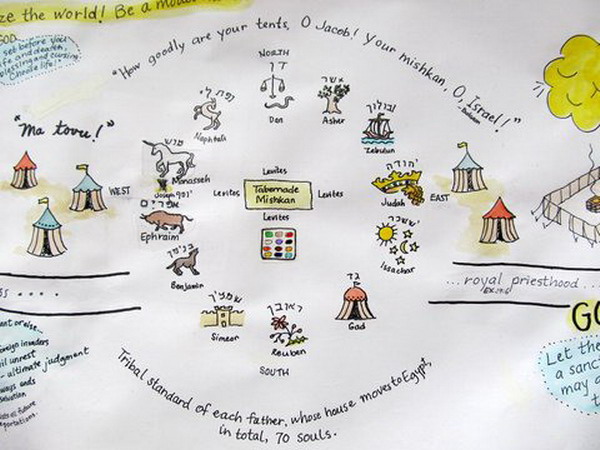
http://www.britam.org/DanCo.html
When we then built the Temple, we again assembled around God, with the Temple being the center of our community and we built ourselves around it.
Pillars of Cloud and Fire
A huge concept in the end of exodus and beginning of Leviticus is this idea that we were on the move with the Tabernacle. Sometimes we would move and sometimes we would stay in place. How did when know when to move or when to stay?
| 34And the cloud covered the Tent of Meeting, and the glory of the Lord filled the Mishkan. | לדוַיְכַ֥ס הֶֽעָנָ֖ן אֶת־אֹ֣הֶל מוֹעֵ֑ד וּכְב֣וֹד יְהֹוָ֔ה מָלֵ֖א אֶת־הַמִּשְׁכָּֽן: | |
| 35Moses could not enter the Tent of Meeting because the cloud rested upon it and the glory of the Lord filled the Mishkan. | להוְלֹֽא־יָכֹ֣ל משֶׁ֗ה לָבוֹא֙ אֶל־אֹ֣הֶל מוֹעֵ֔ד כִּֽי־שָׁכַ֥ן עָלָ֖יו הֶֽעָנָ֑ן וּכְב֣וֹד יְהֹוָ֔ה מָלֵ֖א אֶת־הַמִּשְׁכָּֽן: | |
| 36When the cloud rose up from over the Mishkan, the children of Israel set out in all their journeys. | לווּבְהֵֽעָל֤וֹת הֶֽעָנָן֙ מֵעַ֣ל הַמִּשְׁכָּ֔ן יִסְע֖וּ בְּנֵ֣י יִשְׂרָאֵ֑ל בְּכֹ֖ל מַסְעֵיהֶֽם: | |
| 37But if the cloud did not rise up, they did not set out until the day that it rose. | לזוְאִם־לֹ֥א יֵֽעָלֶ֖ה הֶֽעָנָ֑ן וְלֹ֣א יִסְע֔וּ עַד־י֖וֹם הֵעָֽלֹתֽוֹ: | |
| 38For the cloud of the Lord was upon the Mishkan by day, and there was fire within it at night, before the eyes of the entire house of Israel in all their journeys. |
https://www.chabad.org/library/bible_cdo/aid/9901/jewish/Chapter-40.htm
When God was most fully in the Mishkan, the cloud would settle upon the people of Israel and they would settle in place until the cloud once again lifted.
In contemporary society, I think that when we describe a cloud settling upon us, we associated with negative things. Clouds are associated with grumpiness, melancholy, confusion (a cloudy mind).
What if, in fact, the clouds are meant to slow us down, because clouds are when the holiest work is being done in our life?
Feeling stuck and restless is a horrible feeling. Feeling tethered in a world where, as Brene Brown wisely says
IT TAKES COURAGE TO SAY YES TO REST AND PLAY IN A CULTURE WHERE EXHAUSTION IS SEEN AS A STATUS SYMBOL
The willingness to slow down and take stock of ourselves is critical. If we keep moving on, tromping through the wilderness of this world without calibration, we are going to be lost forever.
Often it is in those stuck moments that we are doing the best of God’s work. Staying in the discomfort and wrestling with the uncertainty is sacred stuff.
I believe it was a minister named Craig Groeschel who said wisely:
Sometimes the greatest act of faith is faithfulness- staying where you’re planted.
I feel this deep in my bones. Staying in place and scribbling on a blank page until I feel connected with God and moved to actually write something can be so frustrating. But it is in those congested, cloudy moments that real magic breaks through.
So… where does this lead?
The importance of the Sanctuary
We have seen throughout our history that our people struggle when we don’t feel God’s presence or Glory, as the text refers to it. This results in us making some poor calculations. We create idols, we elevate ourselves, we run away from our connection to God’s presence entirely.
This is why we need the mikdash, the sanctuary. It is not because God needs a place to live, it is because we need to know where to find God. This doesn’t necessarily mean that all of God resides within the walls of the sanctuary, but instead, it means that we know where to go when the clouds are heavy around us and we need to commune with the divine.
Our temples are there to serve this purpose, but maybe you find God at the top of a mountain, or in the arms of a loved one, or in an oversized chair with your dog next to you.
Mikdash. The home of the divine. I believe it is within us and around us.
I have so much more to write on this, but rather than obsess or edit. I will send this out into the world in it’s glory-filled, cloud-laden form.
 And You Shall Love