We’re officially in the season where we count the 49 days between the start of Passover and Shavuot. Counting the Omer is one of the rituals that I feel most connected to in Judaism. I love the structure. I love the blessing. I love the connection to the agricultural roots of my people (Shavuot traditionally celebrates the wheat harvest). Most of all, I love the fact that in Kabbalah, counting the Omer is associated with looking inward and examining our soul traits.
Each week is dedicated to one of the seven lower sefirot (attributes) and then each day within that week is associated with a sefirot. That means that day one is dedicated to chesed in chesed. Lovingkindness in lovingkindness.
Today is day five, so we are considering hod (humility) in chesed (lovingkindness).
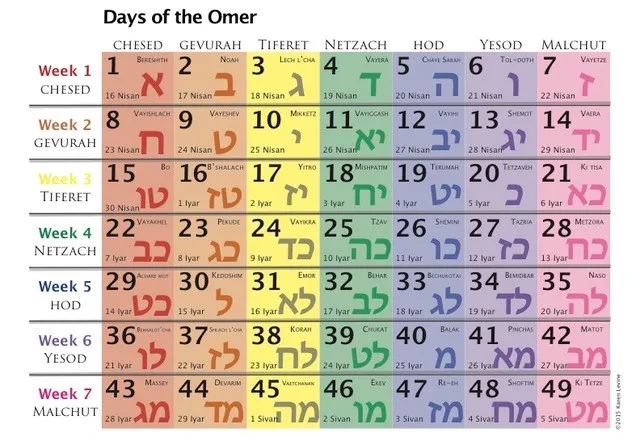
Image via https://aarecon.org/counting-the-omer-during-quarantine/
Historically, I have felt so excited about the Omer that I end up never feeling like I did it well enough. There are all kinds of books, apps, pages, and websites to help you stay on track with the counting of the Omer. One of my dearest friends and rabbis posts about her Omer counting every year and I always find it incredibly meaningful.
This year, I subscribed to the text message service from At the Well coupled with using the MyOmer app. I get the prompt, I read the things, I pray the prayer, and I close my phone. It honestly hasn’t felt that transformational or impactful. Until tonight. Until we got to the idea of hod (humility) in lovingkindness.
Because I am a woman that struggles to show up. I worry that if I can’t show up perfect, then it’s not worth showing up at all. I think about this in regards to my work and my friendships.
I spent 8 years working as a bedside nurse. I was a good nurse. I was never the BEST bedside nurse, but I was the best I could be. Now, my primary work is in education and I pick up hours here and there at the bedside. And honestly…I pick up less and less. It’s not because I don’t like it. Every time I get the chance to meet a patient, assess a patient, perform tasks and connect with families, I love it. My issue is an inferiority complex. I am just not very good at it anymore. I no longer have a grasp on the rhythms, the workflows, or the structures. I don’t remember phone numbers and struggle to complete certain tasks. I doubt my gut. I don’t know my teammates more and more.
I can’t tell if I am actually as bad at bedside nursing as I think I am, or if I just don’t know how to show up without being great. Do I lack the humility to show up and be a weaker nurse? Do I lack the humility to walk away from the bedside entirely because I am not longer a helper? How can I honor myself and my world with lovingkindness while tempering it with humility?
In my relationships, I am again reminded of the struggle between humility and lovingkindness.
One of my oldest and dearest friends was married this year. She and her spouse are truly precious to me. When they were married, celebrating them felt very important to me. I knew I wanted to get them a gift, but I couldn’t decide on what. Nothing was big enough or emotional enough or special enough or beautiful enough. So I got them nothing. By not wanting to show up poorly, I just didn’t show up.
Similarly, I am in a group text with some of my closest friends from the bedside. As I’ve gotten progressively more removed from the bedside, I am growing less and less aware of what they are talking about and going through. I am not the one dedicating 40-60 hours a week taking care of critically ill people. They are. And I am just the part time clinical instructor that sometimes shows up to play pretend. I feel like an imposter. I feel unworthy. So I feel myself shrinking away, or even worse, showing up as a shittier version of myself. Trying to shove my two cents where it was not needed or wanted. I feel myself shrinking away.
What day 5 of the Omer teaches me, is that humility in lovingkindness means knowing your limitations, and loving yourself through them. It means sending the wedding gift three months late and letting go of the need for it to be the best. It means signing up for shifts to take care of people the best you can or being willing to take the feedback that you’re not longer valuable at the bedside and leaving it to those who are more capable. It means showing up vulnerably in your friendships and being only who you are, not trying to be more or less than that.
It means doing your daily Omer practice and letting it be as meaningful or trite as it’s going to be that day. Because sometimes, the best we can do is show up.
 And You Shall Love